
Sugar and Milk Lead ShelfSight Price Increases as Grocery Prices Rise 1.0%
ShelfSight’s latest Price Pulse shows tracked grocery prices up 1.0% between 9 Aug and 7 Sept. Sugar rose 1.9% and milk 1.2%, making them the fastest-rising major categories in the latest snapshot.
Sugar and Milk Lead ShelfSight Price Increases as Grocery Prices Rise 1.0%
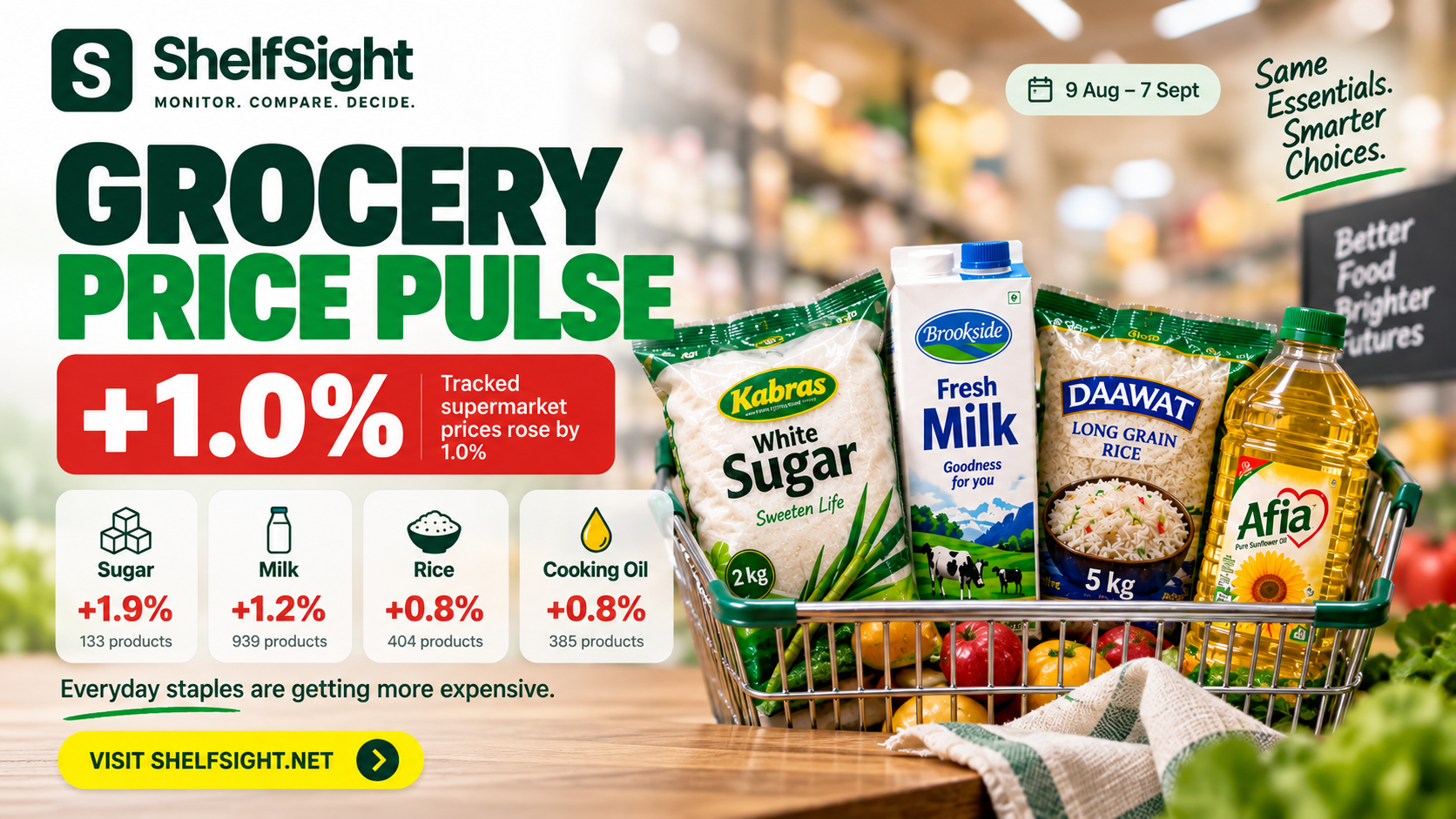
ShelfSight’s latest Price Pulse shows that tracked supermarket prices increased by 1.0% between 9 August and 7 September.
The overall movement is modest, but two everyday household staples stand out clearly:
- Sugar: +1.9%
- Milk: +1.2%
Both are rising faster than the overall ShelfSight Price Pulse.
That matters because these are not occasional purchases. They are products that appear regularly in household baskets.
The latest ShelfSight Price Pulse
For the period 9 Aug–7 Sept, ShelfSight recorded:
- Overall Price Pulse: +1.0%
- Sugar: +1.9%
- Milk: +1.2%
- Rice: +0.8%
- Cooking Oil: +0.8%
The movement is broad.
All four major categories highlighted in this update recorded increases.
Sugar is rising fastest
Sugar recorded the strongest category-level increase in the latest Price Pulse.
Across 133 tracked sugar products, the category moved up 1.9%.
That is almost twice the overall 1.0% movement.
For shoppers, this is significant because sugar is bought frequently and appears across a wide range of household uses.
A movement of 1.9% in one month does not mean every sugar product increased by exactly that amount.
It means the broader tracked category has shifted upward.
Milk remains under pressure
Milk is the second-fastest rising category in the latest update.
Across 939 tracked milk products, ShelfSight recorded an increase of 1.2%.
This follows the supply pressure ShelfSight has been tracking in recent weeks, where fresh and long-life milk availability has become tighter in some supermarkets.
The latest Price Pulse suggests that milk is still one of the categories shoppers should watch closely.
Rice and cooking oil also moved higher
Rice and cooking oil each rose 0.8%.
That puts them below sugar and milk, but still firmly in positive territory.
The fact that all four highlighted categories moved up at the same time is important.
A household may not feel a 0.8% increase on one product.
But when sugar, milk, rice and cooking oil all rise together, the effect can become more noticeable at basket level.
Why small increases matter
Grocery inflation is often felt gradually.
A few shillings on sugar.
A few more on milk.
Another increase on rice.
Another on cooking oil.
Individually, these movements can look small.
Together, they can push the cost of a household basket steadily higher.
This is why ShelfSight focuses not only on individual product prices, but also on category-level movement.
The biggest individual movement was far larger
The latest data also shows that individual products can move much more dramatically than the category average.
The biggest increase in the current snapshot was:
Sam West Daawat Long Grain Rice 5kg: +352.4%
The biggest reduction was:
Laki Laki Greek Blueberry Yoghurt: -69.3%
These extreme movements show why category averages are more useful for understanding the wider direction.
A single product can move sharply because of:
- promotions,
- stock changes,
- listing corrections,
- retailer repricing,
- or pack-size differences.
The category trend helps smooth out those extremes.
Sugar and milk are the categories to watch
The strongest signal in this Price Pulse is not the 1.0% headline number.
It is the fact that sugar and milk are rising faster than the overall tracked market.
For households buying both products regularly, that means these categories may contribute disproportionately to rising basket costs.
ShelfSight will continue watching whether:
- sugar remains above the overall trend,
- milk price pressure continues,
- rice accelerates,
- cooking oil stays stable,
- or category movements begin to reverse.
What this means for shoppers
When staple categories are moving upward, comparing retailers becomes more valuable.
The same sugar, milk, rice or cooking oil product can still be priced differently depending on the supermarket.
That means category inflation does not automatically mean every shopper has to pay the same higher price.
There may still be significant savings available by comparing before buying.
The ShelfSight takeaway
Between 9 Aug and 7 Sept, tracked grocery prices rose 1.0%.
But underneath that headline number:
Sugar rose 1.9%.
Milk rose 1.2%.
Rice rose 0.8%.
Cooking oil rose 0.8%.
Sugar and milk are currently leading the upward movement among the major categories highlighted by ShelfSight.
For Kenyan shoppers, they are the categories worth watching most closely in the weeks ahead.
Monitor. Compare. Decide.
---
*ShelfSight Price Pulse measures short-term movement among tracked supermarket products. It is not Kenya’s official inflation rate. Product availability, promotions, assortment and retailer pricing can change over time.*
ShelfSight evidence