
Milk Is Getting Harder to Find — and ShelfSight Is Seeing the Price Pressure
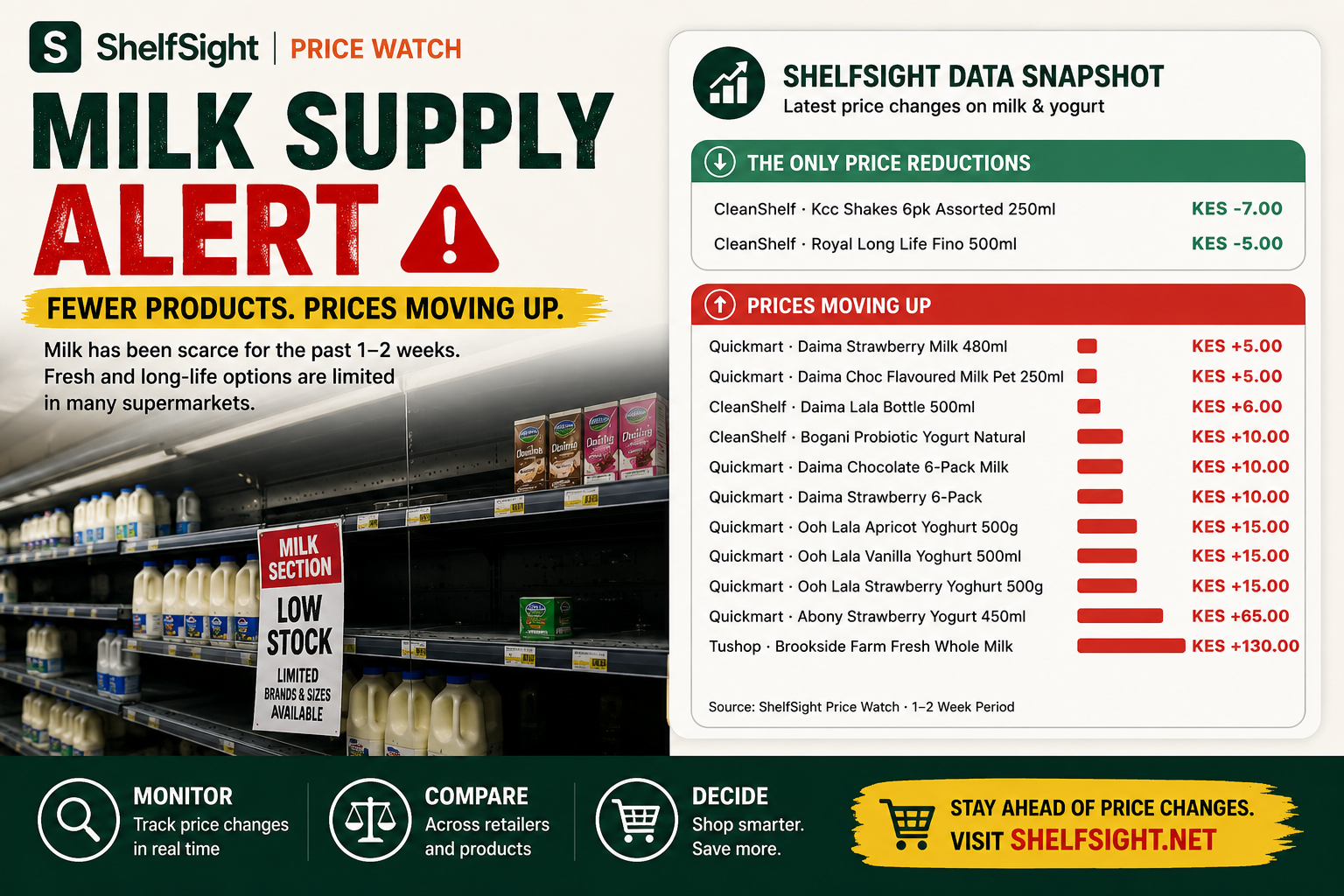
Milk has become harder to find on some supermarket shelves, with both fresh and long-life options affected. ShelfSight’s latest data shows very few milk products getting cheaper while several tracked listings are moving upward.
Milk Is Getting Harder to Find — and ShelfSight Is Seeing the Price Pressure
Milk has become noticeably harder to find in parts of Kenya over the past one to two weeks.
Shoppers have reported thinner supermarket shelves, missing brands and fewer available pack sizes — especially in fresh and pasteurised milk.
ShelfSight’s latest price data is beginning to show the other side of that story:
Very few milk products are getting cheaper.
Across the latest tracked changes, only a small handful of milk listings recorded price reductions, while several others moved higher.
That combination — lower availability and upward price movement — is worth watching.
The shelves are telling a story
Recent reports from supermarkets and retailers have described:
- empty or sparsely stocked milk shelves,
- fewer brands available,
- reduced deliveries,
- limits on how much milk shoppers can buy,
- and higher prices in some outlets.
The Kenya Dairy Board has confirmed temporary supply constraints in parts of the country, with low stock levels, reduced availability of some brands and pack sizes, and delayed replenishment at some outlets.
Formal milk deliveries to processors also fell from 84.4 million litres in June to 81.3 million litres in July, a decline of about 3.7%. Preliminary indications suggest August deliveries weakened further. citeturn630402search3turn630402search5
Fresh milk appears to be feeling it most
According to the Kenya Dairy Board, pasteurised milk has generally been more affected by the current supply constraints.
Long-life milk, including UHT and extended shelf-life products, has remained comparatively more available — but even there, shoppers have reported reduced choice and fewer familiar brands in some stores. citeturn630402search3turn630402search7
That distinction matters.
A supermarket may still technically have “milk” available, while the exact fresh milk brand, pack size or format a shopper normally buys is missing.
That is what scarcity often looks like at retail level:
not necessarily zero milk, but less choice and slower replenishment.
What ShelfSight is seeing
ShelfSight’s latest tracked price movements show relatively few milk products moving downward.
Among the visible reductions in the latest dataset are:
- CleanShelf — KCC Shakes 6pk Assorted 250ml: -KES 7
- CleanShelf — Royal Long Life Fino 500ml: -KES 5
Only a very small number of tracked milk listings recorded declines during the period.
At the same time, a larger number of milk and yoghurt products moved upward.
Some increases are much larger
Among the larger upward movements visible in ShelfSight’s latest data:
- Quickmart — Daima Strawberry Milk 480ml: +KES 5
- CleanShelf — Daima Lala Bottle 500ml: +KES 6
- CleanShelf — Bio Probiotic Yoghurt Natural: +KES 10
- Quickmart — Daima Chocolate Milk: +KES 10
- Quickmart — Daima Strawberry 6-Pack: +KES 10
- Quickmart — Daima Vanilla Milk: +KES 10
- Quickmart — Ooh Lala Apricot Yoghurt 500g: +KES 15
- Quickmart — Ooh Lala Ice Yoghurt 500ml: +KES 15
- Quickmart — Ooh Lala Vanilla Yoghurt 500g: +KES 15
- Quickmart — Ooh Lala Strawberry Yoghurt 500g: +KES 15
- Quickmart — Abony Strawberry Yoghurt 450ml: +KES 65
- Tushop — Brookside Farm Fresh Whole Milk: +KES 130
That last movement stands out.
A KES 130 increase on a fresh milk listing is far more significant than the smaller adjustments elsewhere and fits the broader picture of pressure on fresh milk availability.
Scarcity changes shopper behaviour
When shelves are full, shoppers can compare brands, pack sizes and prices freely.
When supply tightens, that changes.
A shopper who normally buys one brand may have to switch.
A 500ml packet may disappear while a larger or smaller pack remains.
Fresh milk may be unavailable while UHT milk is still on the shelf.
And when choice narrows, shoppers have less ability to move toward the cheapest option.
That is why scarcity can matter even before every product becomes more expensive.
Why are prices moving?
ShelfSight can observe the price movement, but it cannot by itself prove the cause.
However, the broader market context provides useful clues.
The Kenya Dairy Board has attributed the current constraints largely to seasonal production conditions, while retailers have reported lower deliveries and slower replenishment.
Consumer groups have also raised concerns about declining milk intake and pressure on retail prices. citeturn630402search4turn630402search8
So the current picture looks less like an isolated retailer pricing decision and more like a wider supply issue.
Fresh vs long-life milk
One of the most interesting things to watch now is whether fresh milk and long-life milk begin to diverge further.
If fresh milk continues to face tighter supply while UHT milk remains comparatively available, consumers may begin shifting toward:
- long-life milk,
- unfamiliar brands,
- larger pack sizes,
- smaller pack sizes,
- or alternative dairy products.
ShelfSight should be able to see that movement in both availability and price over time.
What shoppers should watch next
The next few weeks will be important.
ShelfSight will be watching for:
- whether fresh milk availability improves,
- whether long-life milk begins tightening further,
- whether more brands disappear temporarily,
- whether price increases spread across more retailers,
- and whether current increases reverse when supply improves.
The ShelfSight takeaway
Milk has become harder to find in a number of supermarkets, and the latest ShelfSight data suggests pricing pressure is appearing alongside the supply problem.
Only a very small number of tracked milk listings are currently moving downward, while several others have increased — some sharply.
The important signal is not one isolated price.
It is the combination of:
fewer products on the shelf + fewer price reductions + more upward movements.
That is exactly the kind of pattern Price Watch is designed to surface.
Monitor. Compare. Decide.
---
*ShelfSight price movements reflect tracked retailer listings at the time of analysis. Availability, promotions and pricing can change. Supply constraints may also vary by retailer and location.*
ShelfSight evidence