
ShelfSight Price Pulse: Grocery Prices Rose 0.8% From 3 Aug to 1 Sept
ShelfSight’s latest Price Pulse shows a 0.8% rise in tracked grocery prices between 3 Aug and 1 Sept, with sugar posting the biggest increase at 2.9%. Milk, flour and cooking oil also recorded upward movement.
ShelfSight Price Pulse: Grocery Prices Rose 0.8% From 3 Aug to 1 Sept
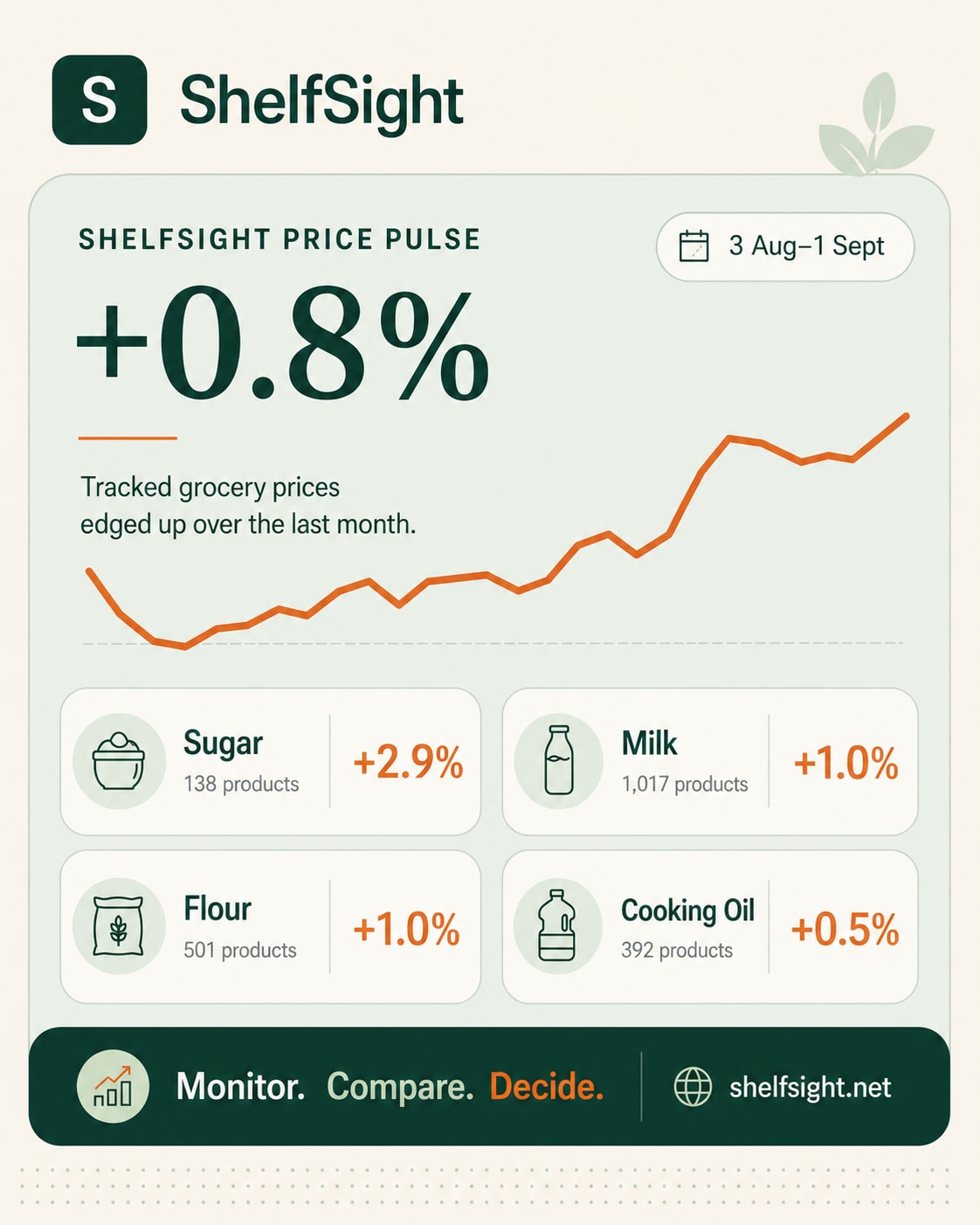
ShelfSight’s latest Price Pulse shows that tracked grocery prices edged upward by 0.8% between 3 Aug and 1 Sept.
While that overall increase may appear modest, the movement inside individual categories tells a more important story. Some of the products that matter most in everyday household shopping — including sugar, milk, flour and cooking oil — all moved up during the period.
The topline number: +0.8%
The ShelfSight Price Pulse is designed to give a simple snapshot of how tracked grocery prices are moving over time.
For the period 3 Aug–1 Sept, the overall movement came in at:
- ShelfSight Price Pulse: +0.8%
This means prices in the ShelfSight dataset were slightly higher at the end of the period than they were at the beginning.
On its own, 0.8% may not sound dramatic. But when price increases begin to appear across several staple categories at the same time, shoppers are more likely to feel the difference in their baskets.
Which categories moved the most?
Among the categories highlighted in this Price Pulse, sugar showed the largest increase.
Category movements
- Sugar: +2.9%
*138 products tracked*
- Milk: +1.0%
*1,017 products tracked*
- Flour: +1.0%
*501 products tracked*
- Cooking Oil: +0.5%
*392 products tracked*
Sugar led the increase
The standout movement during the period was sugar, which rose by 2.9% across 138 tracked products.
That makes sugar the most notable mover in this update and suggests that households buying sugar regularly may have felt the increase more directly than the overall 0.8% headline suggests.
When a category like sugar moves faster than the overall trend, it becomes one to watch closely in the next ShelfSight update.
Milk and flour also moved higher
Both milk and flour recorded a 1.0% increase over the same period.
These are especially important categories because they are deeply embedded in everyday shopping habits. A 1.0% rise in one category may not seem large in isolation, but combined with other increases, it can steadily push total basket costs upward.
Milk also stands out because ShelfSight tracked a particularly large number of products in the category:
- Milk: 1,017 products
- Flour: 501 products
That gives the signal added weight, because the increase is being observed across a broad product base.
Cooking oil remained positive
Cooking oil posted the smallest increase among the highlighted categories, rising 0.5% across 392 tracked products.
Although this was the mildest movement in the group, it still contributed to the general upward pressure seen in the overall Price Pulse.
For shoppers, this is an important reminder that even relatively small increases across multiple essentials can combine into a noticeable difference at checkout.
Why this matters for shoppers
The most useful way to read the Price Pulse is not as a single economic statistic, but as a practical shopping signal.
If several staple categories are moving upward at the same time, then:
- household baskets may become more expensive,
- deals and promotions become more valuable,
- retailer comparison matters more,
- and timing of purchases can begin to make a difference.
This is where ShelfSight becomes useful. Instead of relying only on general impressions that “prices are going up,” shoppers can begin to see which categories are actually moving, and by how much.
What this could mean for your basket
A household buying sugar, milk, flour and cooking oil in the same shopping cycle is likely to feel more pressure than the overall 0.8% figure alone might suggest.
That is because the categories highlighted in this update are not occasional purchases. They are recurring essentials.
When staples move together, the impact tends to show up quickly in the total basket.
The bigger ShelfSight story
Price Pulse is not just about tracking one month’s number. It is about building a clearer picture of how grocery prices move over time.
This kind of data helps answer bigger questions such as:
- Are staples becoming more expensive month by month?
- Which categories are moving fastest?
- Are increases broad-based or concentrated in a few products?
- Which categories should shoppers watch most closely?
The current update suggests a period of gentle but broad upward movement, led by sugar and supported by smaller increases in milk, flour and cooking oil.
Final takeaway
From 3 Aug to 1 Sept, ShelfSight recorded an overall grocery price movement of +0.8% in the tracked dataset.
Among the highlighted categories:
- Sugar rose the most at +2.9%
- Milk increased by +1.0%
- Flour increased by +1.0%
- Cooking Oil increased by +0.5%
For shoppers, the message is simple:
> Even when the headline increase looks small, staples can move faster underneath.
Monitor. Compare. Decide.
---
*This story is based on ShelfSight tracked price data for the period 3 Aug to 1 Sept. Product availability, assortment and retailer pricing may change over time.*
ShelfSight evidence